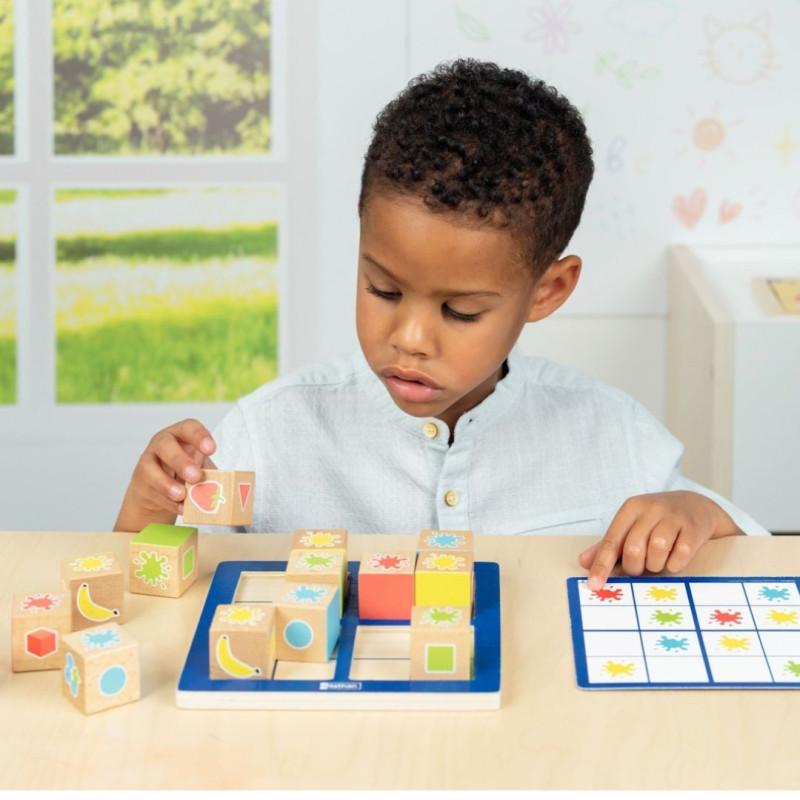
Have you ever watched a child know all the information needed to solve a problem but still struggle to figure out what to do with it? Maybe they can complete a math problem they’ve practiced many times, but become stuck when the same concept is presented differently. Perhaps they know that something didn’t work, but have difficulty figuring out what they could try instead.
These struggles can sometimes involve logic and reasoning—the cognitive skills we use to make connections, recognize relationships, solve problems, consider possibilities, and determine what makes sense.
Reasoning isn’t simply about knowing the right answer. It’s about learning how to think through a problem.
Logic and reasoning help us analyze information, recognize relationships, solve problems, consider possibilities, and make thoughtful decisions.
We use reasoning when determining the best way to approach a problem, recognizing patterns, learning from mistakes, considering alternatives, or deciding what to do when our original plan doesn’t work.
These skills are involved in far more than academics. We use them when following a recipe, deciding how much time we need to get somewhere, figuring out why something isn’t working, understanding another person’s perspective, organizing our day, or deciding what to do next.
Reasoning isn’t simply about finding the “right answer.” It also involves learning how to think through a problem.
Logic and Reasoning in Everyday Life
An individual realizes they have 30 minutes before leaving for church. They still need to get dressed, eat breakfast, brush their teeth, and gather anything they’re taking, like a Bible. Deciding what needs to happen first, estimating how long each task will take, and adjusting the plan if they’re running behind all involve reasoning alongside other cognitive skills.
Different Types of Reasoning
Just like our other cognitive skills, reasoning and logic go deeper. There are 4 types of reasoning I will expound on.
Deductive Reasoning
Starting with information or a rule and using it to reach a logical conclusion.
All the blue Legos go in this container. This Lego is blue. Therefore, it belongs in this container.
Inductive Reasoning
Looking at examples or patterns and using them to make a likely conclusion.
An individual notices dark clouds forming, the wind picking up, and people carrying umbrellas. Based on those observations, they conclude that it will probably rain.
Analogical Reasoning
Recognizing how two relationships are similar.
Bird is to nest as bee is to _____.
This requires understanding the relationship—not simply knowing the vocabulary words.
Cause-and-Effect Reasoning
Understanding that actions and events have consequences.
“If I leave my ice cream sitting in the sun, what will happen? Why?”
What Can Difficulty With Logic and Reasoning Look Like?
A learner might:
- Know facts but struggle to apply them in a new situation.
- Become stuck when a familiar problem is presented differently.
- Have difficulty recognizing patterns or relationships.
- Struggle to determine what information is important and what isn’t.
- Have difficulty predicting what might happen next.
- Struggle with cause and effect.
- Have difficulty considering more than one possible solution.
- Continue using an approach that isn’t working rather than trying something different.
- Have difficulty explaining why they chose an answer.
- Rely heavily on memorized procedures instead of understanding the underlying concept.
A student might memorize:
7 × 8 = 56
but reasoning asks something different:
If you forgot 7 × 8, how could you figure it out?
Could you use:
7 × 7 = 49
49 + 7 = 56Now we’re moving from recalling an answer to thinking about relationships between information.
Don’t Rescue the Learner Too Quickly
When a child struggles, adults naturally want to help. So we give the answer, tell them the next step, correct the mistake, or show them exactly what to do.
But sometimes the cognitive work happens during the struggle to figure it out.
Instead of immediately giving the answer, we can ask questions that help guide their thinking. For example:
What do you already know?
What do you notice?
How are these alike? How are they different?
What have you tried?
Did it work? Why or why not?
What else could you try?
What do you think will happen next?
How did you figure that out?Mistakes are a part of learning, exploring, and reasoning. Instead of correcting a wrong answer, we can say, “Tell me how you got that answer?’. Reasoning also involves recognizing when a strategy isn’t working and being willing to change approaches. The goal isn’t to create learners who never make mistakes. It’s to help learners become better at thinking through what they’re doing, evaluating the result, and deciding what to try next.
Logic and Reasoning Work With Other Cognitive Skills
Logic and reasoning don’t happen in isolation. To solve a problem, a learner may need to pay attention to important information, hold details in working memory, process what they see or hear, retrieve previous knowledge, compare possibilities, and remain flexible enough to change strategies.
This is why a struggle that looks like a “reasoning problem” may actually involve several cognitive skills working together.
How Does Equipping Minds Help Logic and Reasoning?
Logic and reasoning are woven throughout the Equipping Minds program rather than treated as isolated skills. Learners are encouraged to observe carefully, compare information, recognize relationships, categorize, sequence, identify patterns, consider possibilities, and explain their thinking.
Equipping Minds incorporates concepts influenced by Reuven Feuerstein’s mediated learning approach and Aristotle’s Categories, translating complex principles into approachable, engaging activities. Rather than simply giving learners answers, the goal is to help them become more intentional about how they observe, organize, compare, reason, and solve problems.
Ultimately, I don’t simply want a learner to become better at getting the right answer. I want them to become more confident in knowing what to do when they don’t know the answer.
Can they stop and observe? Can they identify what they already know? Can they recognize relationships, consider possibilities, learn from an unsuccessful attempt, and try another approach? This ultimately teaches the learner critical thinking skills and strengthens their logic and reasoning, which will benefit them in all of life.
 Neural Pathways of Hope
Leave a comment