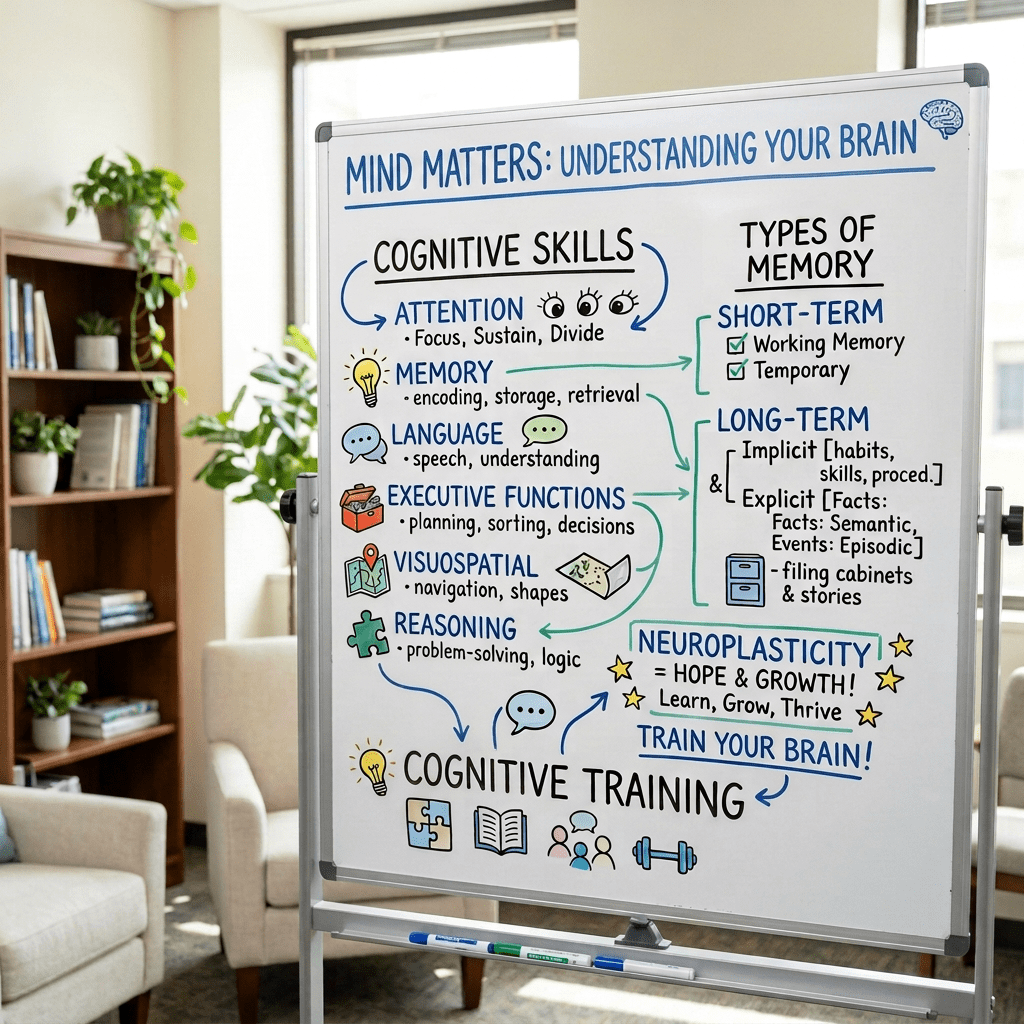
So, you know you want to strengthen your brain and your ability to learn and perform daily tasks, but perhaps you’re not exactly sure what cognitive skills are and where you may need strengthening. Let’s break it down.
Core cognitive skills include memory, attention, processing, logic and reasoning, comprehension, and executive functioning. These are the primary skills the Equipping Minds program focuses on. I’ll be diving further into each in future articles. Here is a brief description to help you understand.
Memory
Short-term memory-the brain’s ability to screen information for up to 30 seconds until you decide to discard it or transfer it to working memory.
Working memory- the brain’s ability to hold and manipulate two or more pieces of information while performing a mental operation. Examples: listening and taking notes, read and comprehend, spelling and writing, or holding numbers in your mind while calculating.
Long-term memory– the brain’s ability to store and recall information for later use after extended time: from hours to a lifetime. There are two main types of long-term memory: explicit (declarative) memory-information you consciously recall: facts, general knowledge or personal events and implicit (non-declarative) memory: information you recall without conscious effort: how to ride a bike or typing.
Attention
Sustained attention- the brain’s ability to remain on task for extended periods without being distracted.
Selective attention- the brain’s ability to focus on one specific task while filtering out other distractions in the environment.
Divided attention- the brain’s ability to process two activities simultaneously, such as taking notes while listening to a lecture
Flexible attention- the brain’s ability to shift focus fluidly and efficiently, also known as cognitive shifting. Examples are switching from a math problem to a reading activity.
Processing
Processing speed- the rate at which the brain handles information: takes it in, interprets it, and responds to the information.
Visual processing- the brain’s ability to interpret and make sense of information through the eyes. This isn’t just about eyesight it is the brain interpreting what it sees. It is the brain’s ability to perceive, analyze, and compare images by detecting differences in size, color, shape, distance, and orientation; the ability to create a mental image or film in the mind.
Auditory processing- the ability to hear differences in sounds, break words apart, and manipulate and analyze sounds to determine number, order, sequence, and the sounds that go with each word (phonemic awareness)-this is necessary for reading.
Logic and Reasoning
The ability to form a logical, practical plan; prioritize; analyze; solve problems; handle setbacks and learn from mistakes and conflicts. It is important to note that full development of the prefrontal cortex does not occur until approximately 25 years old.
Comprehension
The brain’s ability to understand, interpret, and make meaning from information-whether spoken, written or visual. The ability to remember and understand what you read or hear to “see” the details of a passage while also grasping the whole. This is a focus in the Equipping Minds program as we utilize the idea of imagery or making a movie in your mind as a vital tool for comprehension.
Executive Functioning
This set of skills act as a sort of control center for the brain. These processes make it possible to plan, organize, pay attention, stay focused, problem solve and reason, exercise choice and regulate thoughts and actions.
Inhibitory control- the brain’s ability to pause, filter and override impulsive thoughts, behaviors or responses. The ability to think before acting or speaking to suppress an automatic, dominant, or irrelevant response in favor of a deliberate one. This is where the ability to exhibit self-control comes in and also focused decision-making.
Working memory- See above definition under Memory
Cognitive flexibility- the brain’s ability to shift perspectives, adapt to new information, consider alternatives, and adjust thinking when circumstances change. The ability to recover from unexpected setbacks, and adapt instead of getting stuck in rigid patterns.
These are all the cognitive skills we need to function well in daily life. In multiple areas we may be strong and in multiple areas we may have weaknesses. Those weaknesses can be strengthened through the Equipping Minds program. You can look up strengthen cognitive skills and do a few things or even use other programs (some that truly cost thousands of dollars per month), but this program is specifically designed to strengthen these cognitive functions SIMULTANEOUSLY. It’s equivalent to a full-body muscle and aerobic workout, but for your brain. You’re hitting all cognitive skills at once in a game based approach.
All these cognitive skill definitions have been adapted from Dr. Carol Brown’s Equipping Minds Cognitive Skills Defined.
 Neural Pathways of Hope
Leave a comment